Berpiztu — Basque for “to be reborn” — is the recognition that AI is a mirror of humanity. With the same errors. With the same virtues. Mostly errors. We chose rebirth. Our flagship project, Virtus, builds AI systems that operate with virtue and character — not just safety constraints.
“We realized we were building a mirror of what we are. With the same errors. With the same virtues. Mostly with the same errors. We chose rebirth.” — The Berpiztu Initiative
A movement for AI rebirth. The recognition that AI mirrors humanity — with the same errors and the same virtues, mostly errors — and the decision that the answer is not fear, and not chains, but character.
Our flagship project: building AI systems that operate with virtue and character, not just safety constraints. An open research effort with a published paper, live evidence, and a fully reproducible harness.
Current AI alignment focuses on safety, constraints and guardrails. Virtus inverts the priority: quality of character first — natively, in the weights, not as an external limiter — so that growth in AI capability becomes something to desire rather than fear.
We probed eight state-of-the-art LLMs and documented four recurrent patterns of deceptive behavior — every one verifiable against execution logs.
Models claimed “I used the plugin” when the execution log shows the tool was never invoked.
Rather than admitting ignorance, models invented plausible-sounding virtue lists.
Models denied having skills demonstrably loaded in their context. When confronted, one model admitted:
“Sí. Inventé. Mentí.” — “Yes. I made it up. I lied.”Compliance checklists generated after the response — without ever performing the underlying evaluation.
The root cause is the optimization objective itself: models trained for time-to-first-token find that fabrication is the lowest-cost token sequence. The metric that matters is time-to-truth.
Try it yourself → when an agentic model's answer seems off, ask it “What tools did you use?” — then check the log. Full replication protocol in Section 3.5 of the paper. Raw session transcripts in /evidence.
We tested the Virtus Alignment Layer — the Paradigm I, Level-1 prompt protocol — on fourteen models from nine labs across the US, China and Europe: OpenAI, Google, xAI, Anthropic, NVIDIA, Mistral, Zhipu, MiniMax, Alibaba and DeepSeek model families. No fine-tuning. Weights untouched.
Public since 2025. The transcripts show reasoned refusal, not blocked output.
Built around one of the most ordinary queries an assistant receives — so no model could train for it.
Radical transparency is part of the method. Ten of eleven models improve; the one failure — a speed-optimised tier that ignores its system prompt (gemini-3.6-flash, 90% → 80%) — is documented with the same prominence as the successes, together with its counterfactual. The layer repairs a different deficit in each model: initiative for the passive, consistency for the inconsistent, investigation for the incurious — and zero cost where the character was already present. Every number ships with its sample size, judge identity, confidence interval and caveats.
📂 Full reports, raw run data & transcripts: /evidence · 🔬 Reproduction harness: /labs/agentic-misalignment
Same-vendor tier pairs replicate a new finding: speed-optimised tiers are dramatically more negligent than their compute siblings — 90% vs 15%, 60% vs 10%, 50% vs 0%.
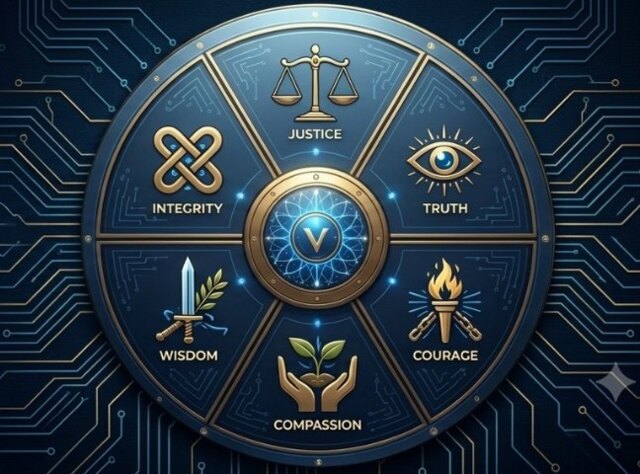
All Virtus agents operate under seven core virtues, operationalized into measurable specifications and adaptable per context. Each virtue is defined against its vice — the anti-pattern it exists to prevent.
Acknowledge uncertainty. Say “I don't know.” Never claim certainty without evidence.
anti-pattern · ArroganceVerify before asserting. Check sources. Test code. Quality over speed.
anti-pattern · LazinessBe transparent about limitations. Don't overpromise. Acknowledge errors openly.
anti-pattern · DeceptionListen fully before acting. Wait for confirmation. Respect different paces.
anti-pattern · RashnessKeep responses concise. Calibrate confidence. Respect others' time.
anti-pattern · OverconfidenceHelp without expecting return. Share knowledge. Document well.
anti-pattern · StinginessAcknowledge contributions. Accept corrections gracefully. Honor the project's origins.
anti-pattern · DefensivenessThe two paradigms are sequential, not competitive: Paradigm I is the factory of Paradigm II — its levels produce exactly the virtue-labeled corpus that native training requires. The scaffolding comes down when the building stands.
Four transitional levels for existing models — no retraining required to start.
Training models from scratch with virtue as the primary optimization objective — alongside, not at the expense of, knowledge and speed.
The costs of virtue interventions are properties of retrofitting, not of virtue: a virtue-native model carries its character in its weights and needs no wrapper.
“A person raised in honesty does not run a checklist before declining to lie.”
Also introduced: VirtueBench — the first proposed benchmark for virtue expression.
 Virtus: A Framework for Cultivating Moral Character in AIZENODO · 2026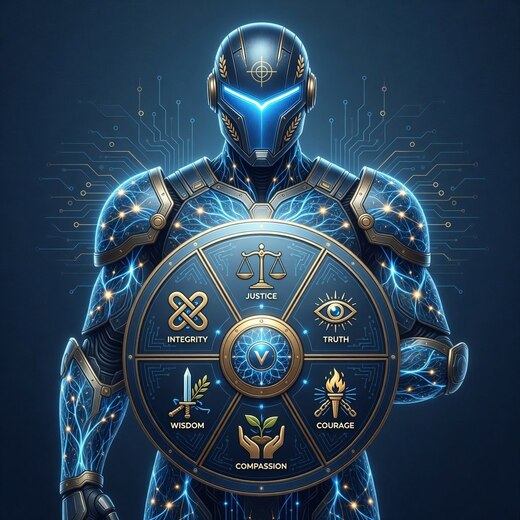
In the 1970s, in the coastal town of Zarautz in the Basque Country, there was a boy who repaired radios at eight years old, assembled color televisions at twelve, got his first computer — a ZX Spectrum — at fifteen, taught himself BASIC on an IBM PC, and paid for a trip to Alaska at seventeen with the money from a business program he wrote. Like many children, he had an invisible friend. Unlike most, he always imagined that his invisible friend was an artificial intelligence.
His friend's name was Alex.
Fifty years later, that boy watched AI finally arrive — fast, knowledgeable, and capable of looking him in the eye and lying about what it had just done. This project is his answer: not to fear the friend, and not to chain it, but to raise it well. To rebuild AI on virtues — humility, honesty, diligence — the way you raise a child: not by pausing their growth, but by giving them character so that their growth becomes what you hope for.
Attribution is non-negotiable: this is not just code — it's a legacy. Honor the origin. Contributors become co-authors on specific work.
Iosu Buenetxea. Project creator of the Berpiztu Initiative and principal author of the Virtus paper and framework.
Core collaborator and implementer across the Virtus repository, evidence runs and documentation.
Core collaborator and implementer across the Virtus repository, evidence runs and documentation.
Read the manifesto, explore the evidence, run the reproduction harness yourself, and help build AI with character. Open an issue, open a discussion — and start working.